Trending
This story is from October 26, 2015
Why Tamil writers don't sync up
Constrained by a narrow framework of ideas, they are reluctant to join the nationwide writers' protest
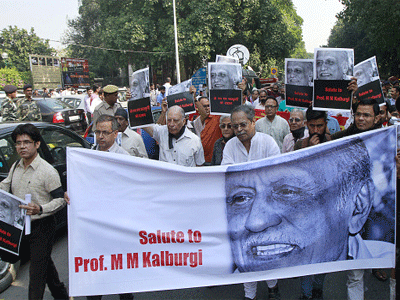
More than 30 eminent writers from all over India have re turned their Sahitya Akademi awards to protest against the cold-blooded murder of Kannada writer M M Kalburgi, himself a recipient of honours from the Akademi. It is widely believed that Kalburgi was killed in retaliation for his rationalist writings.

This protest by writers is personal in each case, not a concerted action in the manner of a trade union or guild. Therefore, any move to chastise other writers for not making a similar gesture of protest would be churlish and inappropriate. It would diminish the very creative freedom out of which such protests might be engendered in future.However, for those of us in Tamil Nadu, it could be worth while to explore the reluctance of Tamil writers to join the pan-Indian writers' pro test by returning their awards.
As with other Indian languages, Tamil writers practise their art and perform their social roles within the local milieu. The nature of the local milieu and its attitude towards the literary world are therefore important in understanding the public conduct of these writers. At least three local factors can be identified as the underlying reasons for the weak response from the Tamil literary fraternity.
First is the accent on partisanship in the local milieu. For the past 50 years, socio-political discourse in Tamil Nadu has been entirely taken over by a polarising framework and corresponding ideologies. As elucidated (approvingly) by the late scholar M S S Pandian, state politics is defined by two identities: Aryan-Brahmin-Sanskrit-Hindu-India on one side versus Dravidian-non-Brahmin-Tamil language-religion-nationalism on the other. It would be fair to say that all discourse in Tamil Nadu ranging from history and politics to literature, cinema, music, media and even epigraphy is subjected to this framework of oppositions. There is little space for any other discourse.
Any intervention that does not advance this framework is ignored, marginalized or condemned. In such a milieu, writers have only two options: Display their partisanship or sidestep the ruling ideology. There are a large number of writers who declare their affinity to the ruling ideology in direct or indirect ways. However, neither of the above options facilitates their speaking out openly in defence of secular values. Any public attempt to question or criticise the dominant Dravidian ideology locally is met with swift and relentless condemnation.
The tragic incident where the writer, Perumal Murugan was threatened with violence by a community aggrieved by his writings is a case in point. Although protest demonstrations were held in several cities across Tamil Nadu, they did not condemn Gounder Peravai, the castebased organisation which was at the forefront of the agitation against the writer, nor the district administration in Namakkal which had illegally colluded with the bullies by conducting "peace talks" and enforcing humiliating conditions on the writer. In this case, "Hindutva forces", as yet a marginal presence in the state, were propped up as the enemy of convenience. Ten months later, the only entity pursuing legal action on behalf of Perumal Murugan is the Tamil Nadu Progressive Writers and Artists' Association, a body affiliated to CPI(M). This situation attests to a failure of nerve in the fraternity of Tamil writers to address the real issues or their excessively partisan loyalties.
Next, Tamil Nadu does not have a state-level, public-funded autonomous body that can nurture the local literary milieu through conferences, seminars, publications and awards. This is clearly a case of control by neglect. Even the awards from the central Sahitya Akademi, processed through the advisory council set up for the Tamil language, are not conferred without ideological or caste bias. Writers of high standing have ended up being ignored or rewarded very late. Bias in the selection is mitigated to an extent by virtue of a uniform selection process that is followed across the country . Eminent writers not in favour locally cannot be entirely denied recognition but they must suffer the ignominy of coming behind colleagues who are far less accomplished. Given this fraught backdrop, whether or not he is favoured by the system, returning the award may not seem like the best mode of protest to any Tamil writer.
The third factor is the level of engagement of the literary community with issues and events outside the state.The dominant discourse in Tamil Nadu has been built on a strident assertion of Tamil identity. For real and imaginary reasons, the relationship between Tamil society and the Indian nation-state has always been represented as problematic. As a result, the younger generation of writers tends to focus their work exclusively on local communities, their concerns and perspectives.
Their engagement with national issues or those involving other states and regions is fairly weak, except when it is aligned with local priorities. This cultural and political estrangement is another reason for the instinctive silence of Tamil writers when it comes to pan Indian issues.
Finally, we must acknowledge that in recent decades Tamil Nadu has witnessed several in stances of censorship and suppression of the right to expression that have gone unchallenged. Violent crimes against Dalits, which are routine and endemic, pass with out any enduring protest against the oppressors. Civil society in Tamil Nadu is too weak to assert the primacy of liberal values in the public sphere in the face of par ties and groups with an authoritarian bent having their way. Such a secular discourse, free of the compulsions of partisanship, seems impossible given the current configuration of politically powerful forces.
Given these factors, a more vigorous participation in the nationwide writers' protest is simply beyond the ken of Tamil writers.
(The author is a Chennai-based writer and translator)
End of Article
FOLLOW US ON SOCIAL MEDIA






Photostories
Featured In Lifestyle

Popular Categories
Entertainment NewsBollywood NewsTollywood NewsKollywood NewsMollywood NewsMovie ReviewsLatest Hindi MoviesLatest Tamil MoviesMX PlayerParenting TipsHome RemediesWeight LossBeauty TipsParenting TipsHindi VideosHindi Video SongsBhojpuri Music VideosLatest Telugu MoviesBhojpuri Music VideoHindi TV News
Trending in Entertainment
Latest MoviesBollywood MoviesHollywood MoviesTamil Movies 2024Telugu Movies 2024Malayalam Movies 2024Kannada Movies 2024Marathi Movies 2024Bengali Movies 2024Top Rated Movies 2024Best Hindi MoviesBest English MoviesBest Telugu MoviesBest Tamil MoviesBest Malayalam MoviesBest Kannada MoviesBest Bengali MoviesUpcoming Hindi MoviesBest Movies Of All TimeBest Hindi Movies of All Time
Trending in Etimes
Horoscope TodayNumerology Predictions TodayKamala HarrisBrisk WalkingPrince HarryElon MuskDonald Trump DonationsSayuri DeathHaitian President SpeechElon Musk MotherJD Vance Vs Tim WalzEric AdamsKamala HarrisPeanut Butter Vs Almond ButterMagnesium DeficiencyRelationship TipsSean Diddy CombsAlzheimers DiseaseFunniest Wildlife Photos 2024
Trending in TV
Trending in Lifestyle
Trending in Regional
Movie Reviews
Yudhra ReviewJo Tera Hai Woh Mera Hai ReviewKahan Shuru Kahan Khatam ReviewHis Three Daughters ReviewNever Let Go ReviewDancing Village: The Curse Begins ReviewTransformers One ReviewFirst Love ReviewBerlin ReviewThe Buckingham Murders ReviewSpeak No Evil ReviewVisfot ReviewThalapathy Is The G.O.A.T ReviewRebel Ridge Review
Upcoming Hindi Movies
Upcoming Regional Movies
Latest News
Archana Puran Singh opens up on turning down multiple film offers for ‘The Kapil Sharma Show’Seasonal Rituals According to the Zodiac CalendarJr NTR's 'Devara' takes over USA; fans garland actor's photoNayanthara and Vignesh Shivan share emotional notes on their twins Ulag and Uyir's second birthdayPressure Cooker: How Hypertension Can Lead to Heart FailureApple’s Vision Pro 2 may come with M5 chip for powering Apple IntelligenceBest Watches Under 5000: Stylish Picks For EveryoneNFL Offenses Grounded, But Fans Still Soaring: Why TV Ratings Are Thriving Despite Fewer Passing YardsCauvery authority orders Karnataka, TN to abide by SC order'Attempt to defame my govt': Kerala CM Vijayan rejects allegations of independent MLA P V AnvarSS Rajamouli's son SS Karthikeya becomes speechless after watching Jr NTR's 'Devara: Part 1'Ilaiyaraaja thanks Tamil Nadu CM MK Stalin for naming a street after his late friend SPBCameron Green in doubt for India Tests following back injuryWho is Rey Mysterio's wife? Exploring the personal life of the master of the 619Medical Breakthrough: 1st lung cancer vaccine BNT116 clinical trials launched, vaccine based on Covid mRNAWhen Lionel Messi was booed: A rare fan backlash against the football legendBangladeshi fan hospitalised after 'falling ill' in Green Park stands; Police denies assault speculationTirupati Laddu row: Police likely to serve notices to ex-CM Jagan Mohan Reddy ahead of his Tirumala temple visit
Other Group Sites -
ETimes is an Entertainment, TV & Lifestyle industrys promotional website and carries advertorials and native advertising.